
Last Updated: November 15, 2026
Quick Summary
To choose a garage ventilation fan, first match it to your main problem: heat, humidity, or fumes. Then size it in CFM by multiplying your garage’s cubic feet by your target air changes per hour and dividing by 60, and pick an exhaust fan that vents outdoors if you weld, paint, or park running vehicles.
- A 20 ft by 20 ft garage with a 10 ft ceiling holds 4,000 cubic feet.
- At 6 air changes per hour, that garage needs about 400 CFM.
- Every exhaust fan needs a matching intake, such as a gap under the garage door or a louvered vent.
- Mount the fan high for heat and on the wall opposite your intake so air crosses the garage.
- A fan rated around 1 to 2 sones is quiet enough to talk over.
Garage too hot to use? Lone Star Garage Solutions installs insulated garage doors and Lifestyle garage screens for New Braunfels homeowners.
Start With the Problem Your Garage Fan Has to Solve
Picking a garage ventilation fan starts with one question: what are you trying to get rid of? A fan sized for summer heat will not clear welding fumes, and one built to pull out chemical vapors will not fix a garage that turns into an oven by 2 p.m. Central Texas homeowners often end up with the wrong fan, and the fix usually starts with matching the fan to the job.
Heat, Humidity, and Fumes: Three Different Jobs
Heat builds up because a closed garage traps it. For workout spaces, our garage cooling solutions for home gyms cover what actually works.
Humidity is different. In a Texas garage, moisture comes from the slab, wet vehicles, and humid outside air.
Fumes are the safety-critical category. Gasoline, paint thinner, propane, and lawn equipment all release vapors that settle low or spread through the space.
Fix the problem you actually have. Everything below depends on it.
Garage Exhaust Fan Sizing: The CFM Math That Decides Everything
Garage exhaust fan sizing comes down to one number: CFM, or cubic feet per minute, the volume of air a fan moves in a minute. Undersize the fan and it runs constantly without clearing the space.
Here is a common formula for sizing a fan:
- Measure length × width × ceiling height to get cubic feet. A 20 ft × 20 ft garage with a 10 ft ceiling is 4,000 cubic feet.
- Decide your target air change per hour (ACH). For general heat and odor control, 4 to 6 ACH is a common target; for fume-heavy work like welding or painting, go higher.
- Multiply cubic feet by ACH, then divide by 60 to convert to minutes.
That same 4,000-cubic-foot garage at 6 ACH needs about 400 CFM. At 10 ACH it needs roughly 667 CFM. Round up to the next available fan size rather than down.
Air Change Per Hour, Explained Simply
Air change per hour is how many times the full volume of your garage is replaced with fresh air in one hour. Higher ACH means faster clearing but more energy use and more noise, so match the number to the job.
Every exhaust fan needs a matching intake. A fan pulling 400 CFM out of a sealed garage will starve for air and lose performance.
Exhaust vs. Circulation Fans: A Side-by-Side Comparison
An exhaust fan moves air out of the garage to the outdoors. A circulation fan moves air around inside without removing it. They solve different problems, and most garages benefit from knowing which one you actually need.
| Feature | Exhaust Fan | Circulation Fan |
|---|---|---|
| Air removed from garage | Yes, vents outdoors | No, stays inside |
| Best for | Fumes, odors, humidity, stale air | Air movement, comfort, drying surfaces |
| Needs ducting or wall opening | Usually yes | No |
| Handles carbon monoxide | Yes, with proper placement | No |
| Typical noise level | Moderate to high | Low to moderate |
| Energy use | Higher | Lower |
| DIY friendly | Sometimes, wall cutting involved | Yes |
Pros and Cons of Each Fan Category
Exhaust fan pros: removes fumes and moisture at the source, improves air quality, and pairs well with a thermostat or timer. Cons: requires a wall or roof penetration, needs makeup air, and can be noisy if undersized ducting is used.
Circulation fan pros: cheap, quiet, easy to install, and effective at breaking up hot air layers. Cons: does not remove anything, so fumes and humidity stay in the space.
Our take: if you weld, paint, park a running vehicle, or store chemicals, you need an exhaust fan. If you are weighing a powered fan against a screen solution, our guide to retractable screens for garage airflow covers that trade-off in detail.
Garage Exhaust Fan Through Wall: What Mounting Location Changes
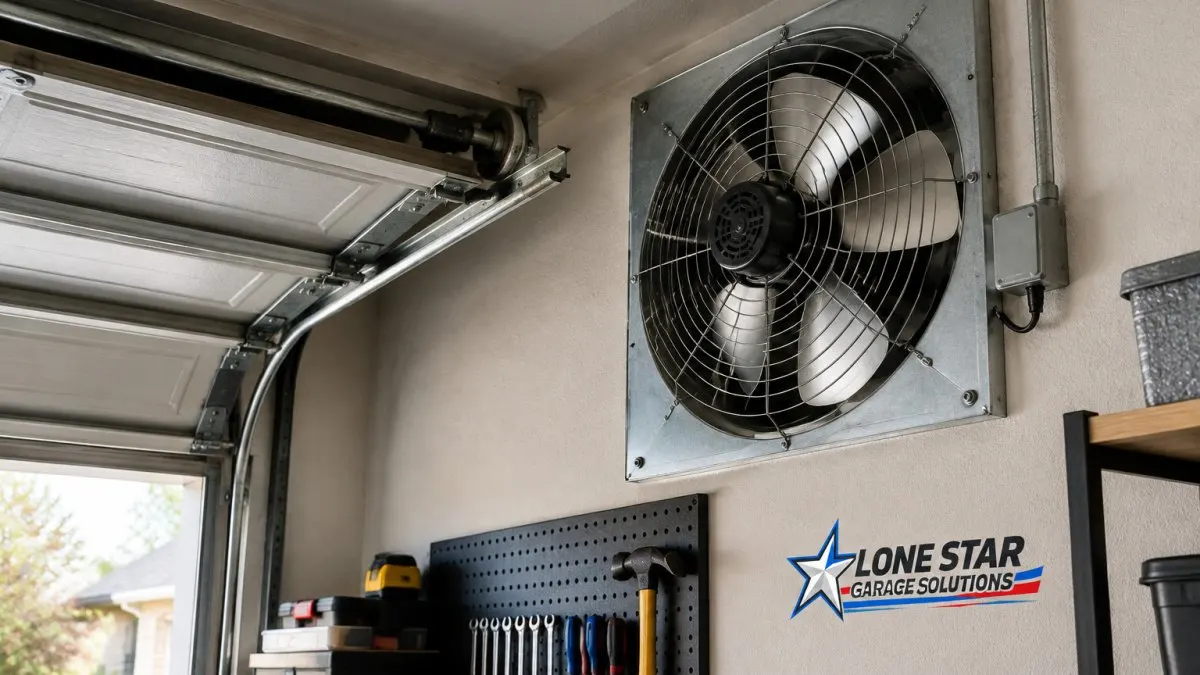
A garage exhaust fan through wall installation is the most common layout for good reason: it is a short, direct path to the outdoors with minimal ductwork.
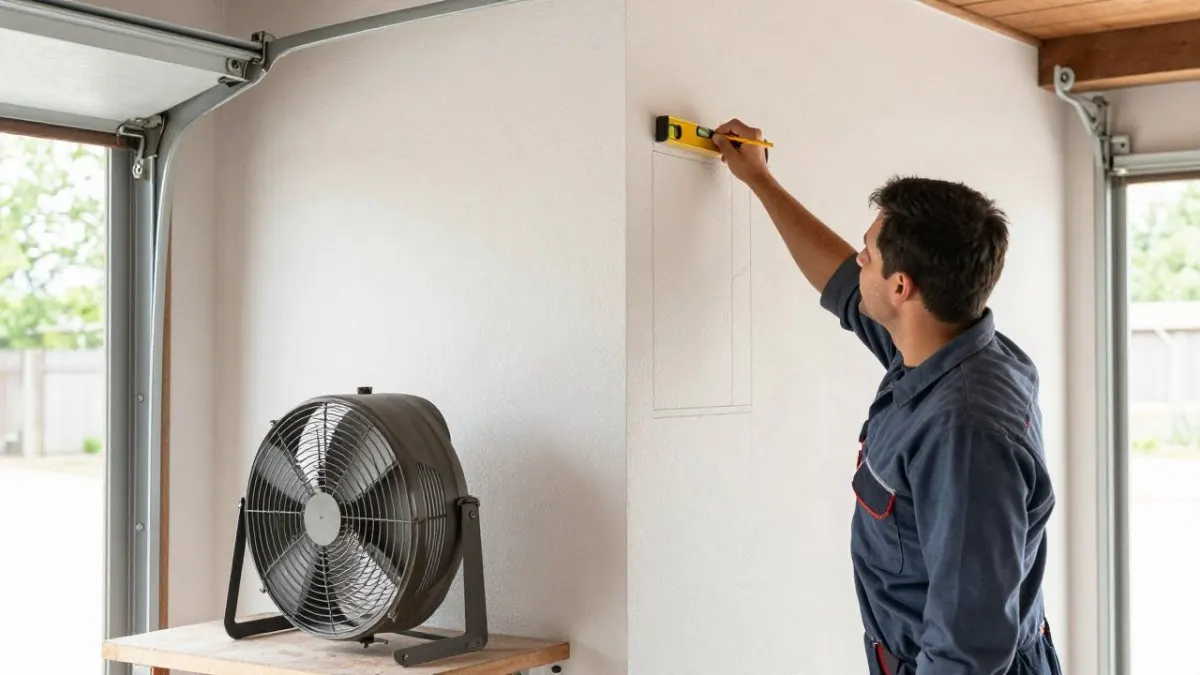
Mount high on the wall for heat, because hot air rises and collects near the ceiling. Mount low for heavier-than-air fumes, though most residential setups compromise by placing the fan high and relying on air movement to lift vapors.
What the Wall Cut Actually Involves
A through-wall install is a sequence, not a single hole. A typical installation runs in this order:
- Confirm the fan’s cutout dimensions and duct collar size from the spec sheet, not the box photo.
- Probe the wall cavity for wiring, plumbing, and blocking before marking.
- Mark the cutout with a level, then drill pilot holes at the corners so the blade does not wander.
- Cut with a reciprocating saw or hole saw sized to the duct, then dry-fit the fan housing and exterior hood before sealing anything.
- Flash and seal the exterior penetration so water cannot track back into the wall, then insulate the duct run if it passes through unconditioned space.
- Wire the fan to a dedicated circuit with a switch or controller, and confirm the damper opens freely when the fan runs.
Watch out: cutting through an exterior wall can hit wiring, plumbing, or a load-bearing header, which is a structural concern.
The Code and Fire-Separation Question Most Guides Skip
An attached garage is treated differently from a detached one because it shares a wall and often a ceiling with living space. Two requirements come up again and again in residential codes and in local inspections:
- Fire separation. The wall and ceiling between an attached garage and the house are typically required to resist fire for a set period, and any penetration through that assembly has to be protected. A fan duct passing through the separation wall needs a fire-rated damper or approved closure, not just a bead of caulk.
- Exhaust discharge location. The fan should discharge outdoors, away from windows, doors, and intake vents, so fumes and carbon monoxide are not pulled straight back into the house or a neighbor’s space.
- Makeup air. A fan pulling hundreds of CFM out of a tight garage needs a path for replacement air, or it will back-draft appliances and starve itself.
Code language varies by jurisdiction and by which edition of the residential code your local authority has adopted, so confirm the fire-separation and penetration details with your local building department before you cut. This is a common place where homeowner-installed fans run into trouble at inspection.
DIY or Hire a Pro? A Straight Decision Framework
A through-wall fan is a reasonable DIY project for a confident homeowner when all of the following are true:
- The wall is a simple exterior frame wall with no living space on the other side.
- You have probed for wiring and plumbing and found a clear path.
- The fan runs on a standard circuit you can tie into safely, or you are comfortable running a dedicated one.
Hire a licensed electrician, and often a contractor for the cut and seal, when any of these apply:
- The penetration passes through a fire-rated wall or ceiling between the garage and the house.
- The fan needs a dedicated circuit, a disconnect, or a controller wired into the panel.
- The wall is load-bearing or you cannot confirm what is inside it.
The labor, electrical work, and water-and-fire detailing often cost more than the fan itself. The labor, electrical work, and water-and-fire detailing are where the real money and risk sit. Getting the penetration right the first time is cheaper than repairing a leak or a failed inspection later.
If your goal is airflow without cutting a hole at all, our garage screen buyer’s guide for Texas heat compares options that vent a garage through the door opening instead.
Why an Exhaust Fan for Garage With Thermostat Saves You Effort
An exhaust fan for garage with thermostat control turns itself on when the space hits a set temperature and off when it cools.
Thermostat models can suit garages that bake in the afternoon sun. Set the trigger a few degrees above the outdoor morning temperature so the fan runs when it will actually help.
The same logic applies to humidity: a humidistat switch runs the fan when moisture climbs, which helps with condensation on tools and the slab. For a broader set of cooling tactics, see our guide on how to cool down a hot garage.
A Garage Exhaust Fan for Fumes: VOCs, Carbon Monoxide, and Air Quality
A garage exhaust fan for fumes needs to vent to the outdoors. VOCs from paint, solvents, and fuel, plus carbon monoxide from engines, do not disappear because a fan stirs them.
Size a fume fan for the worst job you do, not the average day.
CDC information on carbon monoxide poisoning explains the symptoms and why attached garages are a known risk point.
Noise, Energy Use, and Smart Controls Before You Buy
Noise is measured in sones or decibels, and it is the spec buyers ignore until the fan is installed. A fan rated around 1 to 2 sones is quiet enough to talk over. Anything above 4 sones starts to feel like a shop vac running in the corner. Larger ducting and a smooth, short run keep noise down more than any single fan feature.
A Practical Noise Comparison by Fan Type
Manufacturer sone ratings vary, but the pattern across fan types is consistent. Use this as a planning guide, not a spec sheet:
| Fan type | Typical noise range | What it sounds like |
|---|---|---|
| Small circulation fan | Low, roughly 1-2 sones | A quiet box fan on low |
| Through-wall exhaust fan, small | Moderate, roughly 2-4 sones | A bathroom exhaust fan running |
| Through-wall exhaust fan, large | Moderate to high, roughly 4-6 sones | A range hood on high |
| Roof- or ducted exhaust fan | Higher, often 5+ sones | A shop vac in the next room |
| Solar-powered roof fan | Low to moderate, speed varies with sun | Faint hum that rises at midday |
Two rules of thumb cut noise more than any feature: oversize the duct and keep the run short and straight. A fan fighting a long, undersized duct is louder and moves less air than the same fan on a clean run. Mounting the fan on a vibration-isolating pad and sealing the gap around the housing also stops the wall from acting like a drum.
Energy Use: What Actually Moves the Needle
Energy efficiency matters if the fan runs daily. Look for units with efficient motors and, where available, ENERGY STAR certified ventilation products so you are not paying to cool the neighborhood. But the bigger savings come from run time, not motor spec. A thermostat or humidistat that runs the fan only when the garage actually needs it saves more than a marginally better motor running all afternoon.
Smart Controls: The Feature Most Guides Skip
Smart controls are the angle most guides skip, and they are the highest-value upgrade for a garage that doubles as a workshop. The useful integrations fall into a few categories:
- Sensor-triggered fans. Humidity, temperature, and CO2 or air-quality sensors can trigger the fan automatically, so it runs when the garage actually needs it rather than on a fixed schedule.
- Schedules and run-time logging. A smart switch or Wi-Fi controller lets you set run windows, check how long the fan ran, and get a reminder when run hours suggest the fan needs cleaning.
- Remote monitoring. A controller that reports air quality or humidity to your phone gives you a warning before a problem becomes a smell in the house.
Watch out: a smart controller is only as good as its sensor placement.
If you are planning a new door or a screen alongside a ventilation upgrade, reach out to Lone Star Garage Solutions for a quote on the door or screen. For a broader set of cooling tactics, see our guide on how to cool down a hot garage.
Typical noise ranges by garage fan type
Small circulation fan roughly 1-2 sones
Through-wall exhaust fan, small roughly 2-4 sones
Through-wall exhaust fan, large roughly 4-6 sones
Pair Your Fan With the Right Door or Screen
Sizing a fan, choosing a wall location, and matching intake air is straightforward on paper and fussy in practice, especially on a Texas garage that also needs shade and pest control.
Lone Star Garage Solutions is locally owned and serves New Braunfels and the surrounding Hill Country communities.
Fan installation is not a service we offer, but the door and the opening are: see the garage door and screen services we offer in New Braunfels and reach out for a quote.
Your garage does not have to be the hottest, stuffiest room in the house.
Frequently Asked Questions
What’s a good CFM for a garage fan?
It depends on garage volume, not floor area alone. Multiply length by width by ceiling height to get cubic feet, then aim for roughly 6 to 10 air changes per hour for a typical attached garage. A standard two-car garage of about 4,800 cubic feet lands near 480 to 800 CFM. Garages used for welding, painting, or parking a running vehicle should sit at the higher end. Round up to the next available fan size rather than down, since real-world ductwork and static pressure reduce delivered airflow.
Where should a garage exhaust fan be installed?
Place the exhaust fan high on an exterior wall or in the ceiling, because hot air and most solvent vapors rise. Give it a matching intake low on the opposite side, such as a louvered vent or a cracked garage door, so replacement air crosses the space instead of short-circuiting. Keep the fan away from the corner where it would pull air straight back out. On an attached garage, never let exhaust discharge near a bedroom window, HVAC intake, or door into the house.
Do garage exhaust fans need a thermostat?
A thermostat is optional but genuinely useful in a Texas garage. It lets the fan run only when the space crosses a set temperature, so you are not manually switching it on every afternoon in July and forgetting it in January. Look for an adjustable range and a manual override. Humidity-sensing controls also exist and suit garages that stay damp. The control adds convenience, not airflow, so size the fan correctly first and treat the thermostat as the finishing touch.
Can a garage exhaust fan remove fumes and carbon monoxide?
A correctly sized exhaust fan clears paint solvents, fuel odors, and general VOCs by diluting and replacing the air. Carbon monoxide is a different matter: it is colorless, odorless, and dangerous, and a fan is not a substitute for keeping engines out of enclosed spaces or for a CO alarm. Never run a car, generator, or gas equipment in a closed garage expecting ventilation to make it safe. Install a CO alarm in the garage and any adjacent living space regardless of what fan you choose.